
Welcome to my website! I am the Senior Vice Chancellor for Academic Affairs at the Crookston campus of the University of Minnesota and Professor of English.
My disciplinary base is literary study, and my career in higher education is grounded in practicing humanities engagement for individual and collective betterment. My current role is simultaneously academic and administrative, a combination I defined as the scholarly administrator in an article published in the journal of the Reception Study Society in 2023. That essay, “Reading on the Dark Side, Or, The Productive Pleasures of the Scholarly Administrator”, is an intellectual history, a manifesto, and a call to academic affairs administrators working in today’s higher education.

Literary study enjoys a rich storehouse of material on which to draw; the humanities reward study and offer tools for understanding, and for engaging ethically with, the world around us. As a scholarly administrator, literary study is the throughline for my professional activity; this website organizes my work by its themes, cutting across its topics and modalities.
Administrative overview
As a scholarly administrator, I aspire to fold my disciplinary expertise into ethical, strategic, and effective higher education leadership. Since May 2023 I have provided leadership to the University of Minnesota Crookston as Senior Vice Chancellor for Academic Affairs. This role is the chief academic officer for the university. In addition to the faculty-based academic units and their administrators, I also oversee the Roger D. Moe Library, Student Success Center, Office of the Registrar, and our campus academic Director of Online Learning.
Beyond the Crookston campus and the University of Minnesota system, I maintain currency and help shape the future through professional service work such as being a peer reviewer for the Higher Learning Commission (HLC) accreditation processes and serving on the HLC annual conference program advisory committee. I am a regular participant on peer review panels for the National Endowment for the Humanities (NEH) and for the Minnesota Humanities Council grant-making programs. My disciplinary service roles include a four-year term as elected Language and Literature representative to the Executive Council of the Society for the Advancement of Scandinavian Study (2021-2025) and continuous service on the Journal of Popular Culture’s editorial advisory board since 2008.

Previous administrative leadership roles indicate my strengths and priorities as a scholarly administrator. Prior to joining the University of Minnesota Crookston, I was the Associate Provost and Associate Vice President of Academic Affairs at Governors State University, south of Chicago, with responsibility for faculty affairs, including administering the collective bargaining agreement and overseeing faculty development (2018-2022). At GSU, I also served two years as Interim Dean of the University Library, and my first ten months in Crookston I served in the dean-equivalent position of Division Head for Business, Arts, and Education at the Crookston campus (the role is now titled Associate Vice Chancellor). Other academic administrative experience includes serving five times as co-director and teaching faculty on Michigan State University’s English Department Summer Program in Dublin and the West of Ireland between 2001 and 2013. Between 2017 and 2022, I designed and delivered programming around veterans’ engagement with humanities materials, including two separate year-long programs funded by the NEH’s Dialogues on the Experience of War program.
Research overview

My doctoral dissertation, “Britain at its Worst”: The Fictional Milieu of Patrick Hamilton (Michigan State University, 1997) was the first in North America on the English novelist and playwright Patrick Hamilton (1904-1962), and I published an essay on his 1938 play Gaslight: A Victorian Thriller as the source text for the phenomenon known as gaslighting in the Los Angeles Review of Books: “On the Origins of Gaslighting” (2017). The inter-war period has remained one of my research areas. Selected publications addressing literature of the period include “Dorothy L. Sayers and Virginia Woolf: Perspectives on the Woman Intellectual in the late 1930s” in the Virginia Woolf Miscellany (2015) , “Thinking Through Crime: F. Tennyson Jesse” in the Mystery Tribune (2017), “Mabel Seeley’s Intermodernist Crime Fiction” in The Space Between: Literature and Culture 1914-1945 (2023), and “Edith Meiser as The Woman of the Sherlock Holmes interwar radio serial” in Feminist Modernist Studies (2023).
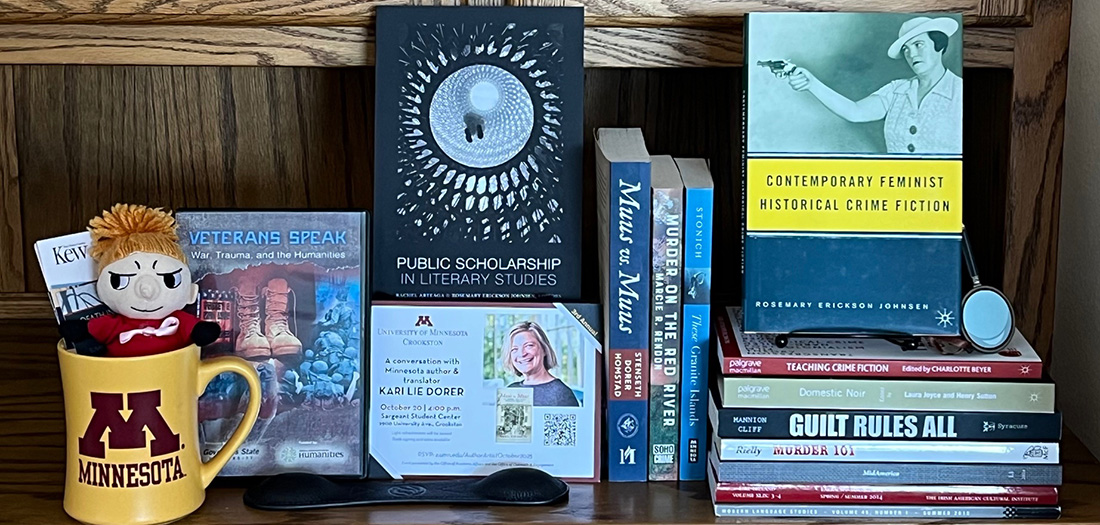
Beyond the interwar period, contemporary crime fiction is another key theme of my research agenda. In my monograph, Contemporary Feminist Historical Crime Fiction (Palgrave Macmillan 2006), I examined the feminist historiography of 1990s women crime novelists who fused historical research, feminist intent, and carefully-constructed crime plots to teach readers about women’s history. Since then, my focus has been on developments in the genre such as the emergence of domestic noir, with publications including “The House and the Hallucination in Tana French’s New Irish Gothic” in Domestic Noir: The New Face of 21st Century Crime Fiction (2018) and “Crime Fiction’s Dublin: Reconstructing Reality in Novels by Dermot Bolger, Gene Kerrigan, and Tana French” in Éire-Ireland (2014). Additional publications, along with my work on crime-fiction criticism and pedagogy, are available on my selected publications page. In 2021, I was awarded the George N. Dove Award, bestowed annually by the United States Popular Culture Association’s Mystery and Detective Fiction Area for “outstanding contributions to the serious study of mystery, detective, and crime fiction.” My career-long commitment to crime fiction studies both supports and benefits from my activities as public scholar, illustrated on my community-engaged scholarship page.